The Great Reset and the New Geopolitics
Richard K. Moore, 20 March 2022
Overview of the Great Reset
The Great
Reset, as the name implies, is about resetting – redefining – the various
systems by which societies operate. Systems such as how pandemics are to be
handled, how popular protest movements are to be dealt with, how the mass media
and social media are to be treated etc. If we consider the unprecedented
covid lockdown regime that was adopted all around the globe, the unprecedented
use of anti-terrorist measures against the peaceful truckers protest in
Canada, and the unprecedented heavy censorship that now pervades
mainstream and social media, we can see that many of our systems are already
being reset. Among the many systems that we can expect to be redefined, one of
the most critical is that of geopolitics.
“For more than a century ideological extremists at either end of the political spectrum have … attack the Rockefeller family for the inordinate influence they claim we wield over American political and over economic institutions. Some even believe we are part of a secret cabal working against the best interests of the United States, characterizing my family and me as ‘internationalists’ and of conspiring with others around the world to build a more integrated global political and economic structure – one world, if you will. If that’s the charge, I stand guilty, and I am proud of it”.
—David Rockefeller, ‘Memoirs’, Random House, New York, 2002, page 405
Financier David
Rockefeller defines globalism as seeking “a more integrated global political
and economic structure – one world, if you will”. Would there even be
geopolitics in a globalist world? Would nation states still exist? Might there
only be provinces of a central world government? If nation states are to
survive under globalism, along with some geopolitical architecture that governs
their interactions, then we can expect that architecture to provide a
stable international order. If the globalists are not planning to govern
directly, over a collection of provinces, then they will need a
self-stabilizing system that can be easily managed from the global
center.
The
existing geopolitical system is of course anything but stable. It is
characterized by frequent wars, unresolved tensions among great powers, and
frequent violations of international law by the United States and its allies.
Whatever new architecture the globalist might have in mind, we can expect the
launch of the Great Reset to bring with it decisive moves toward establishing
that new architecture.
The last time a
new global architecture was established was in 1944 at the Bretton Woods
Conference, which gave us the UN, its agencies, and the Security Council.
Nations came together then, seeking agreement, because they were experiencing
the devastation of a world war, and they wanted to prevent such a thing
from ever happening again. If nations are again to be brought together, given
the many deep issues that divide them, something dramatic must happen, some
kind of war or crisis that makes it clear to the world that a more stable
global order must be achieved.
Globalism
and the WEF: roots of the Great Reset
As Klaus
Schwab confirmed at the recent gathering of the World Economic Forum (WEF)
in Davos, the Great Reset project has been launched, and we can expect
shock-and-awe ramifications. But this is not the launch of a new project,
rather it is the latest step in a project that has been going on for many
years. The Great Reset marks the deployment stage of plans that globalist
elites have been pursuing for decades, as revealed above by David Rockefeller
in his memoirs.
This globalist cabal stands behind the WEF agenda, and we need to take seriously what the Davos folks are telling us. The globalists hav long been preparing to seize power, and what we are seeing now is the actual seizing, a global coup d'etat.
The WEF has been playing an important role in these preparations. For the past 30 years it has run courses for Future Global Leaders for young people who show leadership qualities. In the course they get leadership coaching, and they get inculcated into the globalist perspective. Later these people work their way into positions of leadership, where they can use their position to advance the globalist agenda. ThisWEF alumni network enables the globalists to effectively manipulate events from behind the scenes. According to WEF documents and statements, the alumni network includes such well-known figures as Justin Trudeau, Emmanuel Macron, Bill Gates, Angela Merkel, Jeff Bezos, Larry Page, Mark Zuckerberg, and Vladimir Putin. Such a network can exercise immense influence over public affairs.
The Ukraine crisis and the multipolar revolution
Whatever their intentions might have been, the US and NATO in fact created a situation in which Russia had to choose between accepting missiles on its borders, or taking action to ensure its security. The US could have easily averted a crisis at any time during the past several years, by urging Ukraine to implement the Minsk agreements. Or NATO could have agreed to permanently bar Ukraine from NATO membership. Instead Russia’s security concerns were totally ignored, pushing Russia into a corner, forcing it to act.
So Russia undertook decisive action, just as the US did in similar circumstances, when it was threatened with missiles in Cuba. The West denounced the operation in Ukraine as an unprecedented violation of international law. In fact it was not at all unprecedented, if we take into account the far more violent attacks on Serbia, Iraq, Afghanistan, Libya, and Syria. What was unprecedented is that it was Russia that took the action, rather than the US and its allies. Russia took a firm stand against the US-dominated, unipolar version of geopolitics. The Russian action marks an historic turning point in the transition from a unipolar to a multipolar world.
The multipolar revolution has been brewing for quite some time. Russia and China have been increasingly challenging US dominance, both militarily and economically. The two nations are unified in their global perspective, and they have some definite ideas about what needs to happen, if we are to have a more stable international order. Putin has long been asking for new security arrangements in Europe, ones that provide for the security of all nations. And this is the core of the agenda China and Russia are now promoting. Russia’s operation in Ukraine establishes a precedent: if the international system is not providing security guarantees, then unilateral actions might be taken, by one great power or another, in order to achieve security.
This leaves us with a very unstable system, one without even a nominal set of agreed rules. It is not unthinkable that we might revert to the geopolitics of the 19th Century, when great power empires competed over the control of sea lanes and the acquisition of territories. This unstable, undefined state of affairs puts every nation’s security at risk. Earlier I suggested, "If nations are again to be brought together, given the many deep issues that divide them, something dramatic must happen, some kind of war or crisis that makes it clear to the world that a more stable global order must be achieved”. The Ukraine crisis has indeed made this necessity clear to the world.
I also suggested, "Whatever new architecture the globalist might have in mind, we can expect the launch of the Great Reset to bring with it decisive moves toward establishing that new architecture”. The Ukraine crisis, brought about through the combined actions of the West and Russia, has indeed served as such a ‘decisive move’, and it came just in time to join in the Great Reset launch.
The role of Russia in these events requires little in the way of explanation. The very existence of Russia was threatened by a hostile and belligerent West, and Russia's response reflected national interests, while simultaneously advancing the globalist agenda. Putin was able to serve both masters without slighting either.
The role of the West, however, has been much more ambiguous. While the actions of the West clearly advanced the globalist agenda, they were at the same time counter to national interests. Poking the Russian bear in Syria, Georgia, and Ukraine, while trying to isolate Russia from Europe, served only to undermine the economic viability of Europe, and to push Russia into closer political and economic ties with China. In order to justify their actions to their publics, Western nations needed to use propaganda and false narratives in order to create anti-Russian hysteria, and to conceal the aggressive nature of their own actions. The West, heavily infiltrated by the WEF alumni network, , faithfully served its globalists masters, while betraying its other master – its own national interests.
As nations come together to define a new basis for geopolitics, we can expect the West to go along with globalist plans, even if publicly the West might claim its agreement came reluctantly, and under pressure. Will Western leaders ever wean themselves from dependance on false narratives?
The new geopolitics
Clearly Russia and China are taking the lead in promoting negotiations over a new system of world order. They can be seen as the front line advocates of the globalist agenda. The core of that agenda, evidently, is a system that guarantees the security of all nations. If global stability is to be achieved by respecting the security of all nations, we need to understand what that really means. We need to take a closer look at what Russia and China – and the US for that matter – consider to be their security needs.
In the case of the US, its security is tied up with the security of the whole Western
world, as exemplified by the existence of NATO
. US security needs extend over a distributed power bloc, aka the Western world. Similarly, China has been claiming special rights in its sphere of influence, particularly on the South China Sea and with respect to Taiwan. Chinese security needs include recognition of these special rights. Russia too has made it clear that its interests extend beyond its national borders. It has acted in defense of Russian speaking peoples in Georgia, in Crimea, and then in Ukraine more generally. Russia’s security needs extend to a regional power bloc that we might call the Slavic-Orthodox world.
These are the kind of security needs that will need to be respected, if military tensions are to be relieved among the great powers, and stability is to be achieved. What we get then is a geopolitical architecture based on protected power blocs, each managed by the dominant nation in the bloc. At least this is what we can expect in the case of the great powers and their blocs. But if a stable global architecture is to be achieved by the Great Reset, it will also need to provide security and stability for smaller nations as well. What can we expect in this regard?
If we have a few large power blocs, embedded in a world of smaller non-aligned nations, we would not have a stable system. There would be a tendency of the blocs to get other countries to align with them. We’d get a new version of empire building, leading to competition and tension among the power blocs. If the new architecture is to be stable, it will need to include structures that inhibit the growth of power blocs.
One way to accomplish this would be to apply the power bloc system universally. That is, divide the whole globe into power blocs, with all nations belonging to one bloc or the other. In addition, it would be necessary for all blocs to have some kind of identity, something that leads them to prefer autonomy to aligning with bigger blocs.
It turns out that just such an architecture was defined in considerable detail back in 1996, in a book that was widely read in top-level policy-making circles. We can be sure that globalist planners were well aware of the book and the details of the envisioned architecture. The architecture has many mechanisms that make for stability. As we review what the book says in the next section, I think it will become clear that this very architecture is the one we are likely to end up with
The
multipolar globe and the Clash of Civilizations
In 1996, Samuel P. Huntington published a landmark book, The Clash of Civilizations and the Remaking of World Order. The US was at the height of its power then, and think-tank strategists were exploring various scenarios for a US dominated global order. A best scenario evidently rose to the top, and Huntington took on the task of documenting it, what we might call the Clash model of world order.
The Clash model is very much like the multipolar order discussed above. It’s based on dividing the world into power blocs, each managed by a regional ‘hegemon’, with the blocs to respect one another’s territory, and with a proviso that some kind of ‘center power’ would be able to manage overall global affairs, and in his book it is of course the US that was presumed to be that center power.
Going on from there, the Clash model attributes many more qualities to these power blocs. For one thing, they are to be established along existing ethnic , religious, and cultural lines, and this can already be seen in the Western, Russian, and Chinese blocs.
In the Clash model, the blocs are to be known as ‘civilizations’, each with its own culture, customs, laws, religious perspective, and economic systems. And again, this is very much what we already see, in the case of the Western, Russian, and Chinese civilizational blocs.
The cultural and structural diversity of the civilizational blocs is of central importance to the Clash model. The diversity helps keep the blocs separated, so that super blocs don’t arise to challenge central power. Even more important, cultural sentiments can be inflamed, through the covert management of events and rhetoric, providing tensions that call for the center to take charge of the outcome. This gives the globalists a lever by which they can exercise efficient control over the course of global events.
It seems that nearly every part of the Clash model is being manifested in today’s world. This could be a case of ‘great minds’ thinking alike, or it could be that the Clash model, as documented by Huntington, has been the actual play book that the globalists have been following. In any case, it makes sense for us to take a look at the rest of the Clash model, and see to what degree that matches our current reality.
In the Clash model, the world is divided into seven specific civilizations, based on ethnic and cultural characteristics of the various regions:
Western, Confucian, Japanese, Islamic,
Hindu, Slavic-Orthodox, Latin-American.
The regions allocated to these civilizations can be seen in the map below. There is also a sub-Saharan African region, but for some reason the Clash model does not assign civilizational status to that region.
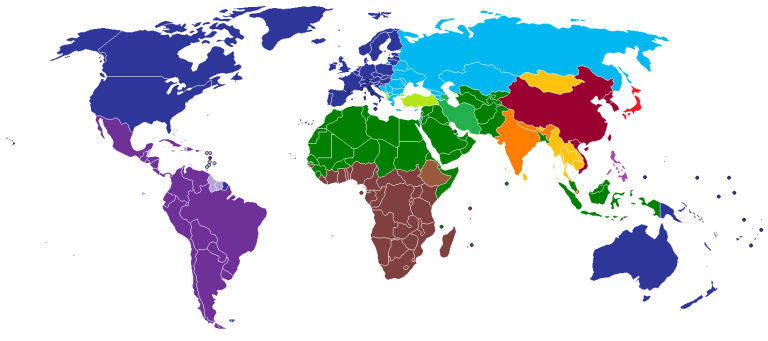
This map does indeed reflect the actual ethnic and cultural divisions that exist in the world today. We do in fact commonly speak of Western Civilization, Chinese Civilization , Muslim Civilization etc. The use of that term in the Clash model makes good sense. And anchoring the blocs with a sense of civilizational identity contributes significantly to the stability of the bloc structure.
Such a geopolitical architecture would be ideal for the globalists, who would be able to manage global affairs from the center with a minimum of effort. Most of the time the system should run on automatic, maintaining global order. But when tensions mount, and disorder threatens, the globalists can then step in, and take control of the outcome. With international relations well under control, the globalists can focus on the rest of their Great Reset agenda.
It is impossible to know for sure, but I will stick my neck out and predict that the new architecture will be very, very close to what Huntington described almost two decades ago. We can of course expect some changes, reflecting a shift from a US-centric design to a globalist-centric design. The most obvious change is the demotion of the US from a position of global dominance, to the role of hegemon of just the Western bloc. And while Huntington’s perspective emphasized the need for maintaining military dominance in a militarily volatile world, the globalist perspective is based on the management of a generally stable world.
____________